For product teams and agencies

Delegate a defined workstream without losing client or product ownership.

The collaboration begins by naming the implementation boundary, repository context, review owner, client-communication rule, and expected handover. I do not present unverified agency work as past proof.

Delegable outputs

Delegation menu

Each option names a reviewable output. “Anything the project needs” is intentionally not an offer.

  • A defined feature

    A user flow with stated acceptance points and a named reviewer.

  • An integration

    A bounded connection to an existing API, CMS, or product surface with known ownership.

  • An interface surface

    A responsive page or flow implemented inside the existing design and code conventions.

  • A correction sprint

    A named set of defects or usability gaps with a finite review boundary.

  • A bounded build

    A small first release whose scope, dependencies, and handover are explicit.

Working contract

Communication boundaries

The agency or product team keeps its relationship and decision authority. Any direct client contact is opt-in and agreed before work begins.

1
Client contact
The partner remains the default client interface. I join client communication only when the role and boundaries are explicitly agreed.
2
Progress updates
One agreed channel, a useful update rhythm, and early notice when a decision or blocker is needed.
3
Review ownership
A named reviewer and acceptance boundary prevent feedback from becoming an open queue.
4
Source and handover
Work lands in the agreed repository with a summary of delivered scope, decisions, known gaps, and next ownership.

Visible method

A reconstructed handoff example

This artifact demonstrates the shape of a useful handoff without pretending it came from a past agency client.

Reconstructed exampleExample status: ready for review
Delivered
The exact flow or feature completed in this workstream, with links to the review surface.
Decision needed
The one product or implementation choice that still needs the named owner's response.
Known gaps
Anything intentionally outside scope, deferred, or still dependent on another system.
Handoff pack
Repository location, relevant notes, review instructions, and the recommended next owner.

No client name, private screenshot, invented quote, or unverified result is represented by this example.

Relevant evidence

What the public evidence does—and does not—show

The public portfolio source demonstrates implementation structure, explicit evidence handling, and reviewable project narratives.

Evidence boundary: No verified public agency or white-label client case is currently published. The collaboration model above is a proposed working contract, not a disguised past-client claim.
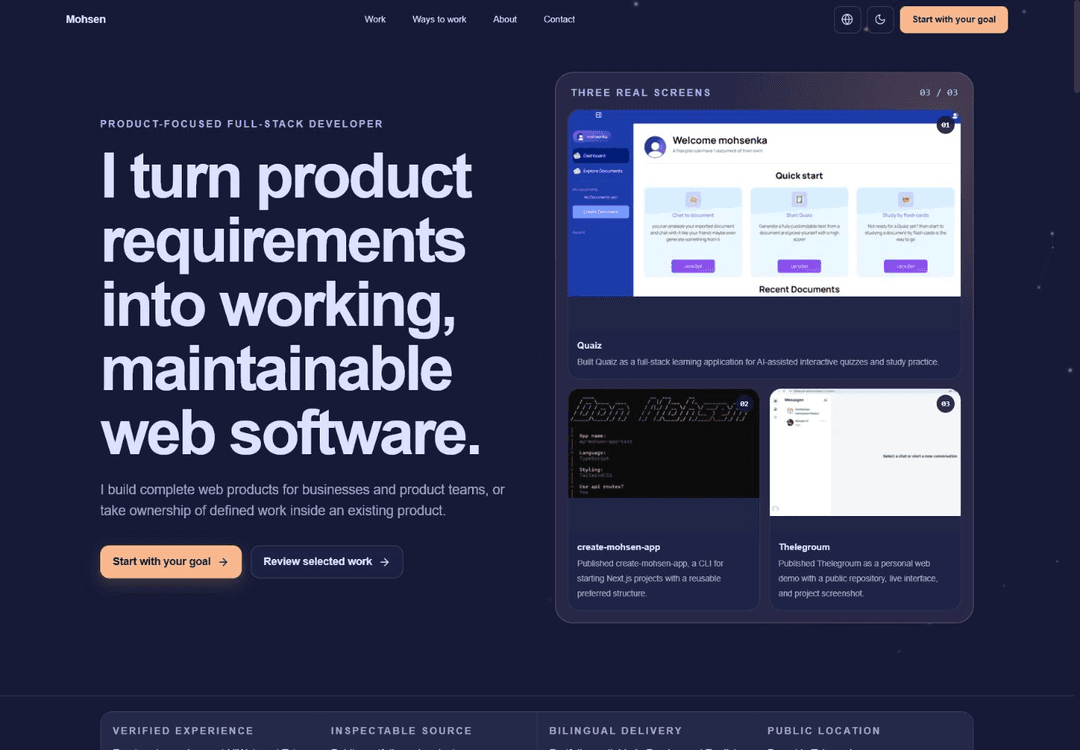
English desktop home page of Mohsen's portfolio

Verified public project

Designed and built this bilingual Next.js portfolio with audience-specific routes, project content, contact flows, and interactive planning tools.

Relevant as inspectable implementation and handover structure. It is not presented as evidence of a previous agency or white-label engagement.

Open supporting source

Fit boundary

A useful fit—and an honest no

The boundary is part of the offer. It protects both sides from starting with incompatible expectations.

Good fit

  • A defined React or Next.js feature that needs focused ownership
  • An agency or product team that keeps client and product direction
  • A delivery that can be reviewed in clear increments
  • A collaboration with explicit responsibilities and handoff

Not the best fit

  • An undefined overflow queue with no product owner
  • A commitment before scope and decision access are clear
  • A partnership that requires presenting unverified work as client proof

After the CTA

What happens next

No automatic commitment and no mystery call. The context is reviewed before a next step is proposed.

  1. 1

    Share the workstream

    Include the output, repository state, client-visibility rule, reviewer, and target review window.

  2. 2

    Align the boundaries

    We compare scope, access, communication, review, and handover expectations before commitment.

  3. 3

    Choose a first reviewable slice

    If the fit is real, begin with one bounded output. If it is not, the gap is stated directly.

Choose one concrete next step

Mohsen
Mohsen
[email protected]

Tehran, Iran

نسخهٔ فارسی

© 2026 Mohsen.