Verified team experience
Worked as a front-end intern at HiWeb, building React and Redux interfaces in a team workflow.
Documented in the public bilingual résumé; it supports React and Redux work in a team workflow.
Open supporting sourceFor recruiters and product teams
The public evidence covers front-end work in two team environments and independent Next.js products. The sections below separate verified experience from the working agreement I would bring to a new role.
60-second scan
The facts currently safe to use for an initial fit decision.
Current start date and preferred employment terms are not published as fixed facts; confirm them for the specific role.
Relevant evidence
Team experience and public source are shown separately so a recruiter or engineering manager can inspect both.
Verified team experience
Worked as a front-end intern at HiWeb, building React and Redux interfaces in a team workflow.
Documented in the public bilingual résumé; it supports React and Redux work in a team workflow.
Open supporting sourceVerified team experience
Worked as a front-end and WordPress developer at Tat Bikeran, integrating React components through the WordPress REST API.
Documented in the public bilingual résumé; it supports React components integrated through WordPress REST API.
Open supporting source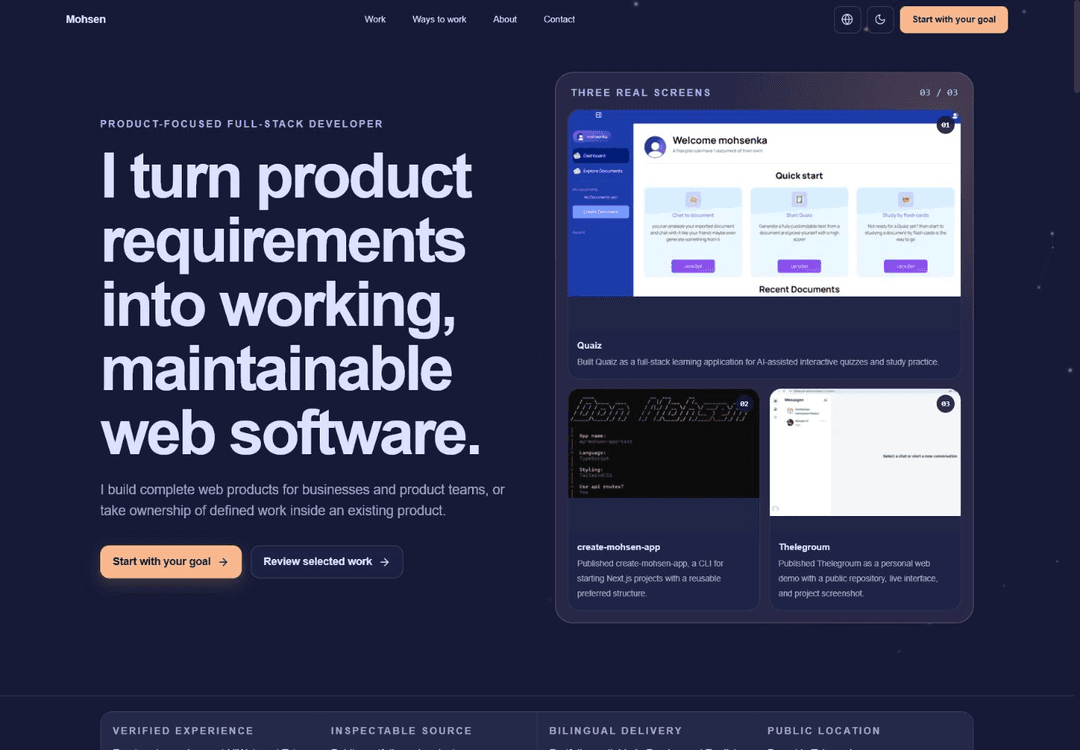
Verified public project
Designed and built this bilingual Next.js portfolio with audience-specific routes, project content, contact flows, and interactive planning tools.
A public bilingual Next.js codebase with audience routes, project narratives, and contact flows.
Open supporting sourceVerified public profile
Maintains public repositories under the DonMohsen GitHub profile.
The DonMohsen profile provides direct access to public repositories.
Open supporting sourceEvidence + behaviour
Verified experience shows the environments and implementation work already documented. The proposed working agreement explains how I would enter a new team without presenting it as a past result.
React and Redux in a team workflow
Worked as a front-end intern at HiWeb, building React and Redux interfaces in a team workflow.
Open the résumé sourceReact integrated with an existing CMS
Worked at Tat Bikeran on React components integrated through the WordPress REST API.
Open the résumé sourceInspectable independent ownership
Public repositories expose implementation choices across this portfolio, Quaiz, create-mohsen-app, and Thelegroum.
Inspect the GitHub profileThese are proposed behaviours for the next role, not claims about every previous team.
Enter through context
Begin with the product goal, repository conventions, review path, and the people who own decisions.
Own a bounded outcome
Take responsibility for a clearly defined change rather than claiming ownership of an unfamiliar system too early.
Make change reviewable
Split work into understandable increments and expose blockers or decisions before they become surprises.
Close the loop
Leave the change, decisions, known gaps, and next owner understandable at handover.
Entry plan
A starting framework for learning before expanding ownership. The sequence adapts to the product and does not promise a predetermined business result.
Days 1–5
Learn the product goal, users, repository shape, team conventions, and review owners.
Visible output: a context map, open questions, and one candidate first change.
Days 6–14
Take one bounded change through the team's real implementation and review path.
Visible output: a reviewable change plus notes on conventions and unknowns.
Days 15–30
Use feedback from the first change to own a larger but still bounded product outcome.
Visible output: the first agreed delivery, decision notes, and a clear next-scope recommendation.
The plan depends on access, team cadence, and the size of the first safe change.
Fit boundary
The boundary is part of the offer. It protects both sides from starting with incompatible expectations.
After the CTA
No automatic commitment and no mystery call. The context is reviewed before a next step is proposed.
Include the product, responsibility, team shape, location expectations, and hiring timeline.
I will identify the strongest fit, the meaningful gaps, and anything that needs direct confirmation.
If the fit is plausible, the next step can be a focused conversation or an agreed technical review—not a generic project pitch.
