Redesign note
Designing one portfolio for several kinds of evaluation
How this site moved from generic portfolio sections toward audience routes, evidence boundaries, and three depths of reading.
3 inspectable artifacts
Read the noteNotes from the work
Three first-hand notes about decisions that can be inspected in this portfolio, create-mohsen-app, and the Project Fit flow. Every note carries its context, constraint, rejected options, decision, learning, and evidence.
This replaces the generic seed-article surface: it does not publish unsupported metrics, demo projects as proof, or implied client experience.
Reference notes
Open a note for the complete decision trail and the artifacts that make it reviewable.
Redesign note
How this site moved from generic portfolio sections toward audience routes, evidence boundaries, and three depths of reading.
3 inspectable artifacts
Read the noteDecision note
Why create-mohsen-app collects intent, rejects an unsafe destination, composes selected templates, and installs last.
4 inspectable artifacts
Read the noteField guide
A first-hand template drawn from the Process page and the Project Fit tool built for this portfolio.
3 inspectable artifacts
Read the noteDistribution assets
Each atom keeps the full-case link and evidence boundary beside the reusable copy, so it can travel without turning delivery into an exaggerated result.
One-line summary
This bilingual Next.js portfolio routes clients, recruiters, delivery partners, enterprise evaluators, and technical reviewers from a relevant promise to registered evidence and a focused next step.
Evidence boundary
Mohsen’s portfolio is a delivered independent bilingual product with public source and three registered real route captures. Conversion, adoption, lead, recruiter-response, and hiring outcomes are not claimed.
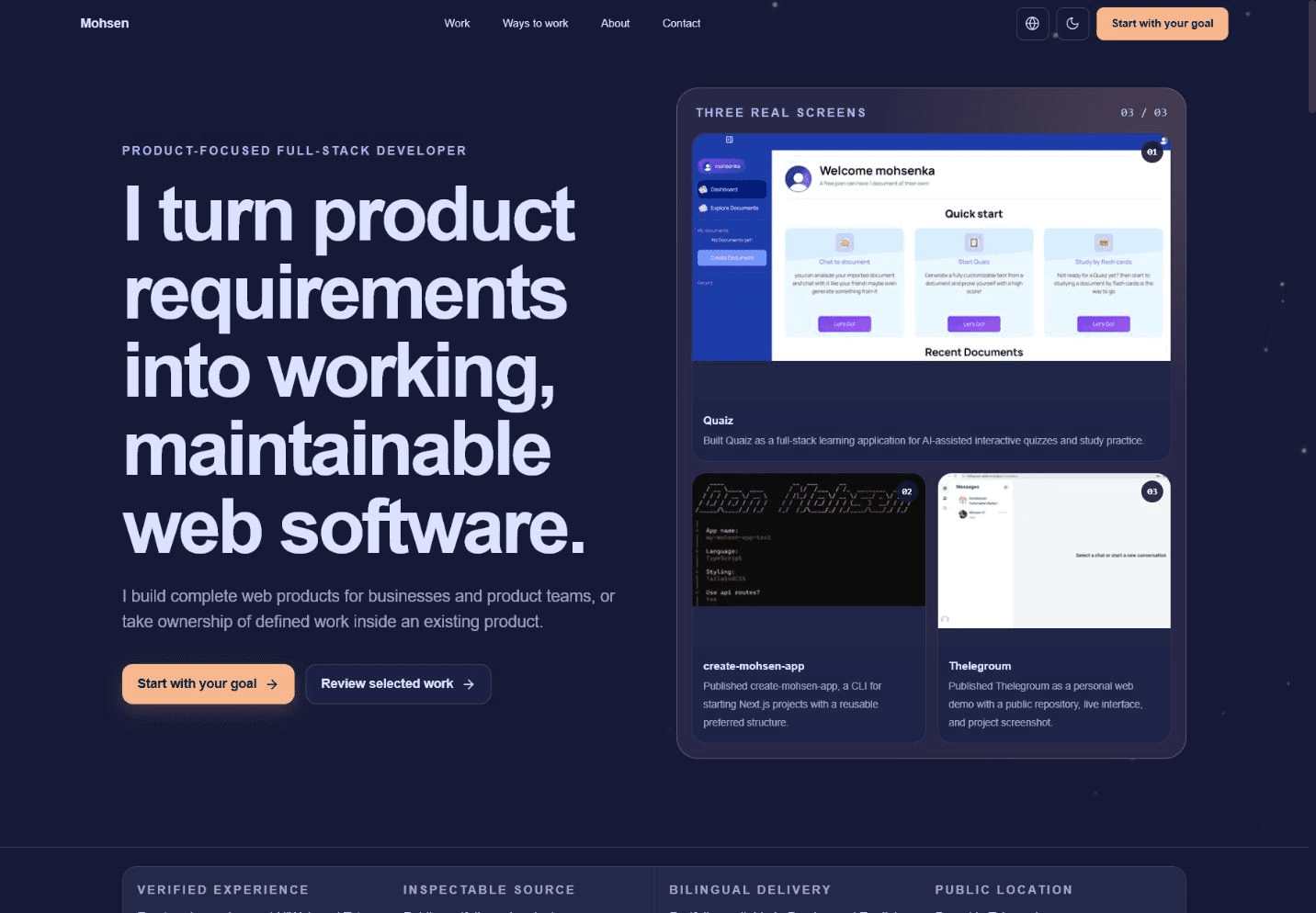
Visual slide
Slide caption: the registered `/en` desktop home capture shows the delivered promise-and-proof hierarchy; separate Persian mobile and Work captures verify RTL responsiveness and the evidence index.
Evidence boundary
Mohsen’s portfolio is a delivered independent bilingual product with public source and three registered real route captures. Conversion, adoption, lead, recruiter-response, and hiring outcomes are not claimed.
Decision note
Instead of rendering every database record or trusting persuasive copy, the portfolio registers evidence status, source, asset usage, and project slugs before a case can become public. The extra editorial step buys a reviewable claim boundary.
Evidence boundary
Mohsen’s portfolio is a delivered independent bilingual product with public source and three registered real route captures. Conversion, adoption, lead, recruiter-response, and hiring outcomes are not claimed.
Technical snippet
Visitor intent → locale-aware route → typed audience message → verified Evidence Bank entry → admitted case or tool → intent-preserving contact handoff; unsupported project media never resolves as proof.
Evidence boundary
Mohsen’s portfolio is a delivered independent bilingual product with public source and three registered real route captures. Conversion, adoption, lead, recruiter-response, and hiring outcomes are not claimed.
Interview answer
I treated the portfolio as an evaluation product, not a gallery. I separated audience jobs, moved claim truth into typed evidence registries, kept Navigator and Decision Lab deterministic, and let the cosmic layer fall back before it competes with reading or constrained devices.
Evidence boundary
Mohsen’s portfolio is a delivered independent bilingual product with public source and three registered real route captures. Conversion, adoption, lead, recruiter-response, and hiring outcomes are not claimed.
CTA
Open the full self-case to inspect the audience-routing, evidence-publication, deterministic-assistance, bilingual-responsive, and static-first visual decisions beside the real screens and public source.
Evidence boundary
Mohsen’s portfolio is a delivered independent bilingual product with public source and three registered real route captures. Conversion, adoption, lead, recruiter-response, and hiring outcomes are not claimed.
One-line summary
Quaiz connects study documents, AI-assisted generation, structured quizzes, and persistent practice in a public Next.js learning product.
Evidence boundary
Quaiz is a delivered public product with inspectable source and one registered real screen. Usage, learning impact, and production scale are not claimed.
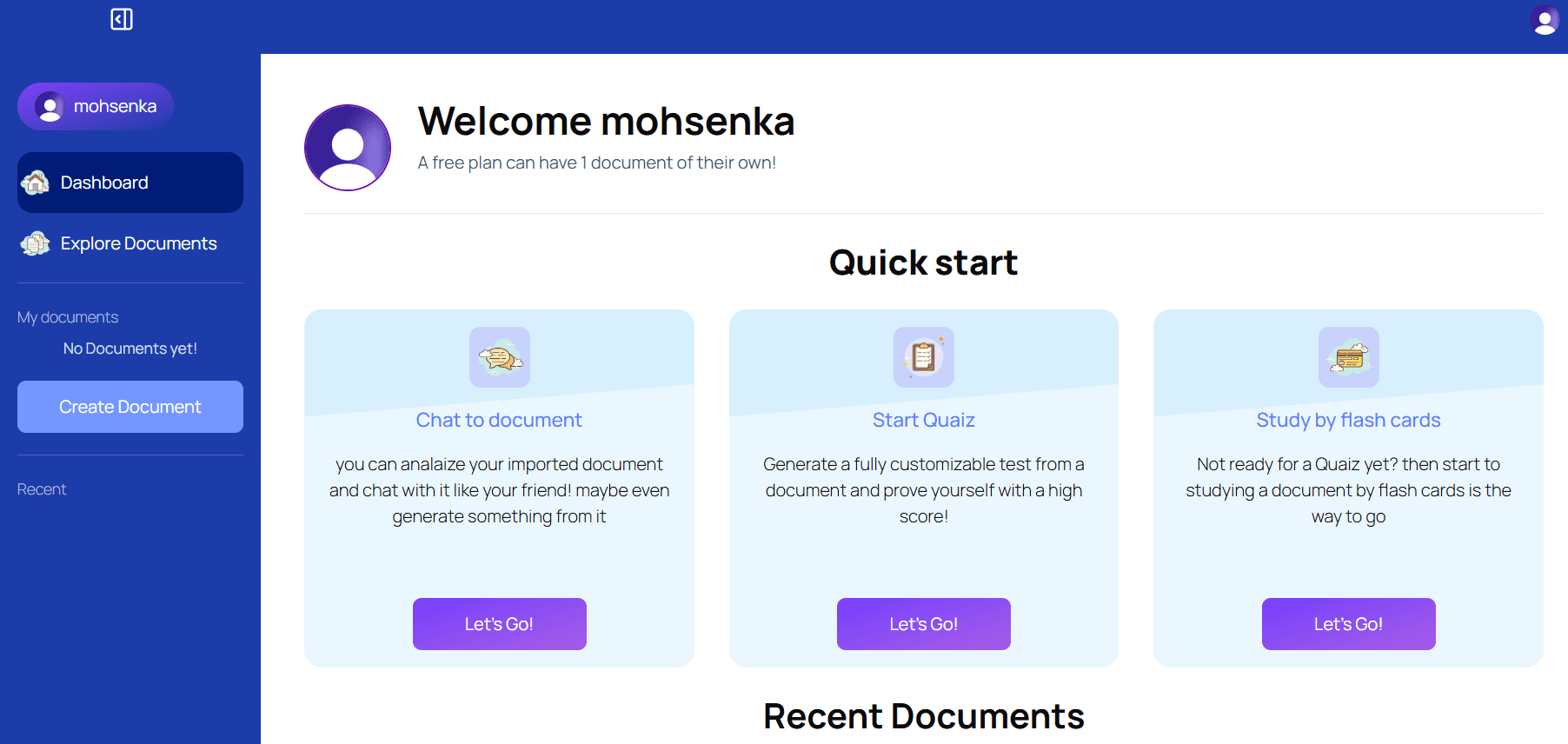
Visual slide
Slide caption: a real Quaiz interface anchors the path from a learner’s study context to inspectable quiz practice.
Evidence boundary
Quaiz is a delivered public product with inspectable source and one registered real screen. Usage, learning impact, and production scale are not claimed.
Decision note
Generated JSON can be syntactically valid and still miss required quiz structure. The chosen boundary parses a named Zod contract before the Prisma mutation instead of trusting the payload or validating during rendering.
Evidence boundary
Quaiz is a delivered public product with inspectable source and one registered real screen. Usage, learning impact, and production scale are not claimed.
Technical snippet
Learner UI → Next.js boundary → structured AI payload → Zod validation → nested Prisma write for the quiz, questions, options, ownership, and result relationships.
Evidence boundary
Quaiz is a delivered public product with inspectable source and one registered real screen. Usage, learning impact, and production scale are not claimed.
Interview answer
When AI output reaches product data, I do not treat it as trusted application state. In Quaiz, I placed validation at the API boundary and kept the document as the ownership context for related learning records.
Evidence boundary
Quaiz is a delivered public product with inspectable source and one registered real screen. Usage, learning impact, and production scale are not claimed.
CTA
Inspect the full case to review the document-centred model, validation decision, nested write path, live product, and evidence limits.
Evidence boundary
Quaiz is a delivered public product with inspectable source and one registered real screen. Usage, learning impact, and production scale are not claimed.
One-line summary
create-mohsen-app turns guided setup choices into a configurable Next.js starter through a published TypeScript CLI.
Evidence boundary
create-mohsen-app is a published independent CLI with public source and a registered real screen. Adoption, downloads, and time saved are not claimed.
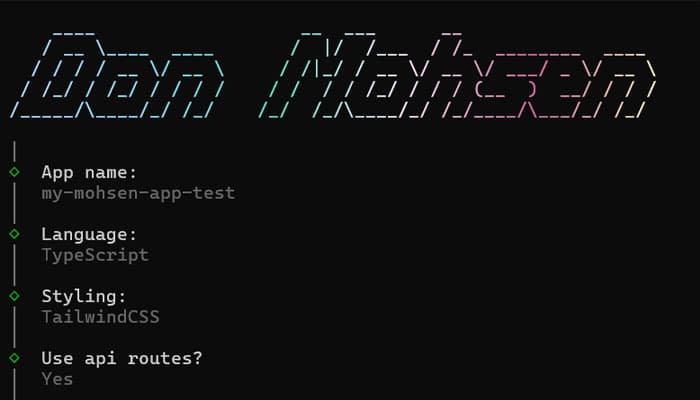
Visual slide
Slide caption: the real prompt surface collects project intent before template composition and the final optional install.
Evidence boundary
create-mohsen-app is a published independent CLI with public source and a registered real screen. Adoption, downloads, and time saved are not claimed.
Decision note
Automatic merging into a non-empty folder risks conflicting with user work. The CLI stops and explains the target conflict, accepting less convenience in exchange for predictable failure.
Evidence boundary
create-mohsen-app is a published independent CLI with public source and a registered real screen. Adoption, downloads, and time saved are not claimed.
Technical snippet
Prompt answers → resolved configuration → target guard → base template plus selected extras → generated files → optional dependency installation.
Evidence boundary
create-mohsen-app is a published independent CLI with public source and a registered real screen. Adoption, downloads, and time saved are not claimed.
Interview answer
For a code generator, I treat cancellation and filesystem safety as product behavior. I collect required choices first, reject unsafe targets, compose only selected templates, and leave installation until the generated files exist.
Evidence boundary
create-mohsen-app is a published independent CLI with public source and a registered real screen. Adoption, downloads, and time saved are not claimed.
CTA
Open the full case to inspect the CLI source, template tree, package, real screen, trade-offs, and current evidence boundary.
Evidence boundary
create-mohsen-app is a published independent CLI with public source and a registered real screen. Adoption, downloads, and time saved are not claimed.
One-line summary
Thelegroum combines authenticated conversations, durable message records, live Pusher events, and responsive navigation in a public Next.js product experiment.
Evidence boundary
Thelegroum is a public independent product experiment with a live demo, source, and one registered real screen. Reliability, latency, scale, and active usage are not claimed.
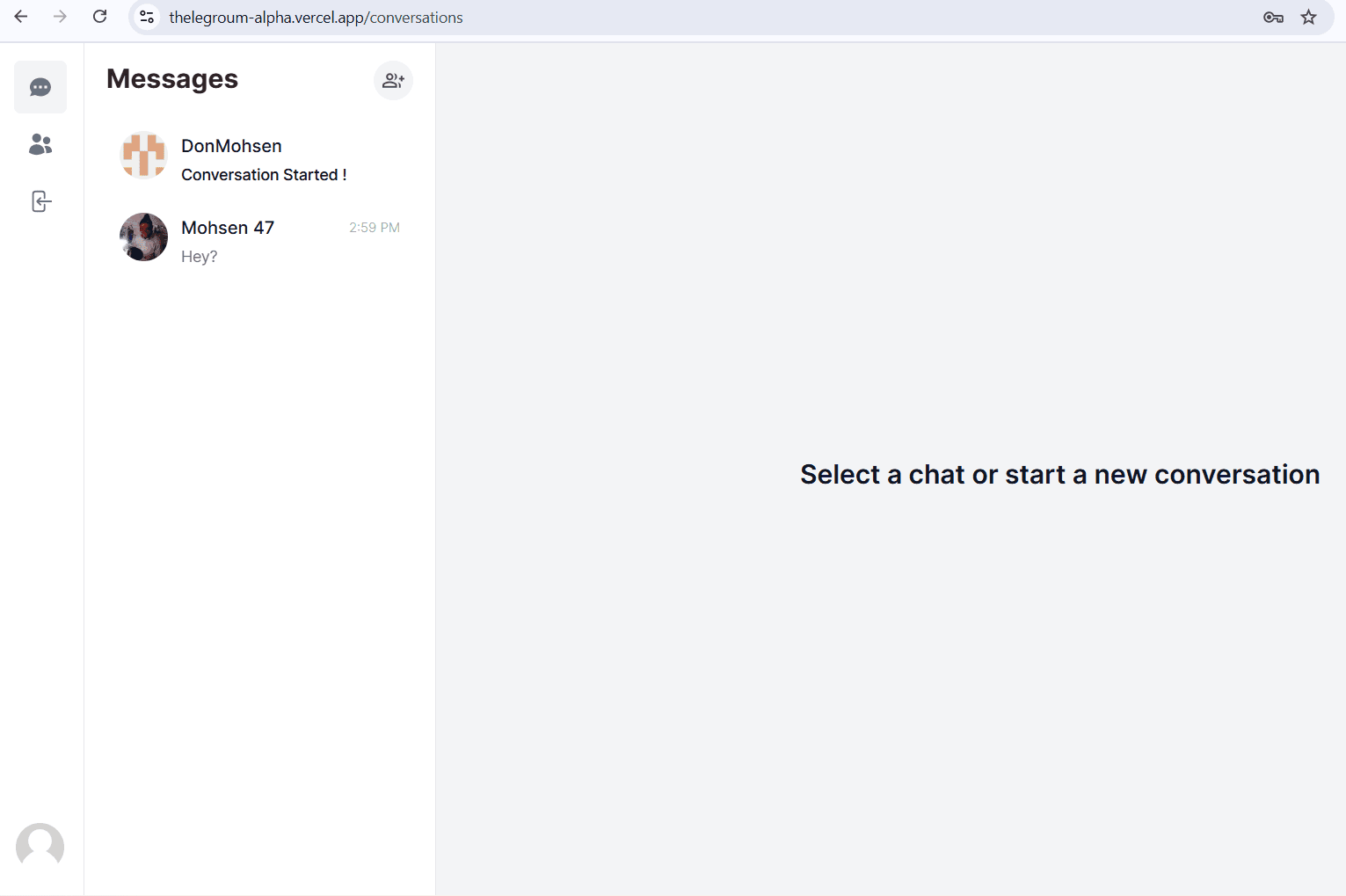
Visual slide
Slide caption: a real conversation interface connects the write-then-publish architecture to the product surface a user sees.
Evidence boundary
Thelegroum is a public independent product experiment with a live demo, source, and one registered real screen. Reliability, latency, scale, and active usage are not claimed.
Decision note
An event-only system is fast but cannot be the conversation history. The chosen path writes the message through Prisma first, then publishes a Pusher event so durable state remains recoverable truth.
Evidence boundary
Thelegroum is a public independent product experiment with a live demo, source, and one registered real screen. Reliability, latency, scale, and active usage are not claimed.
Technical snippet
Authenticated client → Next.js action or route → Prisma conversation write → Pusher channel event → subscribed clients reconcile against durable state.
Evidence boundary
Thelegroum is a public independent product experiment with a live demo, source, and one registered real screen. Reliability, latency, scale, and active usage are not claimed.
Interview answer
In real-time products, I separate authoritative state from delivery signals. For Thelegroum, Prisma owns recoverable conversation history while Pusher improves immediacy; the interface still has to reconcile both paths.
Evidence boundary
Thelegroum is a public independent product experiment with a live demo, source, and one registered real screen. Reliability, latency, scale, and active usage are not claimed.
CTA
Open the full case to review the write route, Pusher adapter, conversation model, responsive shell, live demo, and stated evidence limits.
Evidence boundary
Thelegroum is a public independent product experiment with a live demo, source, and one registered real screen. Reliability, latency, scale, and active usage are not claimed.
